University of Richmond Faculty and Students Launch First-of-Its-Kind Online Visualizer for Studying Ancient Human DNA
UNIVERSITY OF RICHMOND — A team of researchers and students at the University of Richmond has launched a groundbreaking new digital tool that lets users explore ancient human DNA through an interactive global map.
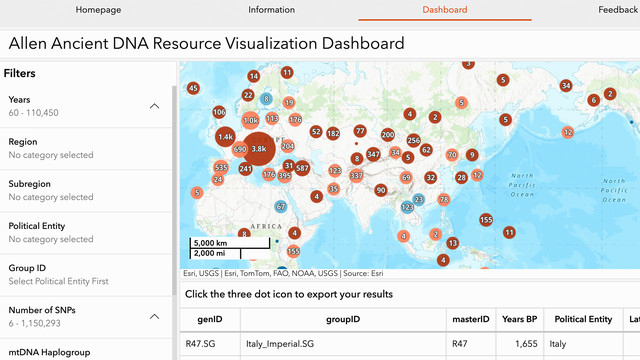
The interface — called the AADR Visualizer — maps more than 13,500 ancient individuals from the Allen Ancient DNA Resource, a public database of ancient human genome data, and offers free, online access to humanity’s genetic past.
Developed collaboratively by biology professor Melinda Yang and geography professor Stephanie Spera, the tool provides a window into how humans migrated, connected, and evolved across time. The project also involved key support from Beth Zizzamia, manager of the University’s Spatial Analysis Lab, and contributions from undergraduate researchers Flora Yi (Class of 2027) and Elliot Delroba (Class of 2024).
“Ancient DNA research has exploded in recent years, but the data can be difficult to navigate without technical training,” said Yang. “Our goal was to take this incredibly rich dataset and make it visually accessible, intuitive, and usable for a wide audience, not just specialists.”
Built using ArcGIS Online, the Visualizer allows users to explore ancient individuals by geographic region, dating, sequencing quality, or population group, then click on specific locations to view sample-level details, metadata, and links to original publications. The interface requires no specialized software and is fully open to the public.
“Beyond its impact, this work reflects one of my favorite things about UR, which is how our collegial, collaborative liberal arts environment naturally fosters and champions interdisciplinary work, said Spera.
A defining feature of the project is its student-driven innovation. Undergraduate researchers assisted in data organization, interface development, and testing, gaining experience with genomics, GIS, and digital storytelling.
“Giving students the chance to contribute to a publicly released scientific tool is part of what makes Richmond special,” said Zizzamia. “It shows how undergraduate research can have global reach.”
The AADR Visual is available to the public here: https://arcg.is/1CyL5n. More information can also be found in Bioinformatics Advances peer-reviewed article.
###