What wild animals can teach us about brain health
New Research
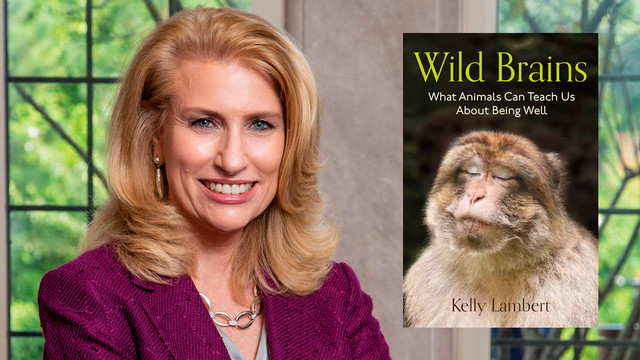
University of Richmond behavioral neuroscientist Kelly Lambert explores the connections between animals’ environments, experiences, and brains in her new book, Wild Brains: What Animals Can Teach Us About Being Well. She makes the case for expanding neuroscience research to include more species and habitats.
What inspired you to write Wild Brains?
Professor Lambert: An unexpected visitor helped change my perspective: a wild rat entered my lab at a previous institution and fashioned a nest using research materials. Its ingenuity made me reconsider how much my familiar laboratory animals could tell me about rats’ capabilities. I wanted to explore animals navigating the challenges of their own habitats—and that journey led me to explore wild rats, as well as raccoons and various nonhuman primates.
I’m also interested in shifting research questions to new areas. We have learned a great deal by investigating brains under conditions of trauma, stress, and disease. We also need to understand what happens when animals have opportunities to explore, play, anticipate, and experience joy.
Why is it important to study animals beyond the laboratory?
Controlled laboratory experiments have been critical for mapping fundamental aspects of the brain. However, as a behavioral neuroscientist, I have grown increasingly concerned that typical laboratory housing limits opportunities for animals to express natural complex behaviors. Observing animals in nature can reveal behaviors and questions we would never have thought to investigate by observing laboratory rodents. Combining these approaches—bringing nature into the lab and laboratory techniques into the wild—will expand what we learn about brains and behavior.
What can different species help us understand?
Specialized species-specific adaptations offer opportunities to investigate different aspects of health and behavior. For example, prairie voles have helped researchers investigate the biology of social bonds, long-lived naked mole rats offer clues about longevity, and a chemical discovered in Gila monster venom contributed to the development of an early GLP-1–based drug. I’m convinced that studying a broader range of species will provide additional ways to explore questions relevant to human well-being.
How does this connect with your research at Richmond?
My lab focuses on experience-based neuroplasticity, or how experiences and environments change our brains throughout our lives. We’re ultimately interested in findings that translate to human conditions such as building resilience against the onset of depression. Conditions such as depression, anxiety, and schizophrenia remain difficult to treat for many people. Expanding our research animal model portfolios lets us consider a broader range of information about healthy and unhealthy nervous systems. This strategy may reveal biological processes and coping strategies we’re missing with conventional laboratory models. Our current work with wild rats (in collaboration with Jonathan Richardson) has already revealed clues about how wild animals cope with prolonged stress.
What do you hope readers take away?
Our brains are intertwined with our life experiences. Learning about how other animals maintain healthy neural networks in their natural habitats may reveal new ways to think about how life experiences influence mental well-being. I ultimately hope readers of Wild Brains will develop a curiosity about other animals' brains and a heightened awareness of the experiences shaping their own brains.